January - December 2025
Honours Thesis: Are the Joneses Winning?
The clearest patterns concerned financial satisfaction. Mental health and life-satisfaction results were less conclusive. These are associations, not proof of causation.
University of Sydney · Sydney, Australia
My incomeWhat others haveThe comparison changes the picture.
Why “Keeping up with the Joneses”?
In middle school, fidget spinners and Nike sports bottles could feel essential simply because everyone else had them. That experience made me curious about how social comparisons shape our choices and wellbeing.
In university (and in general), we are taught that utility economics often starts with our own income and consumption. I wanted to explore the relative side of happiness, i.e. how we feel about what others have.
A local lens on Australian inequality
I combined Australian household survey data with local ABS income data to study how community income gaps related to wellbeing from 2011-2021.
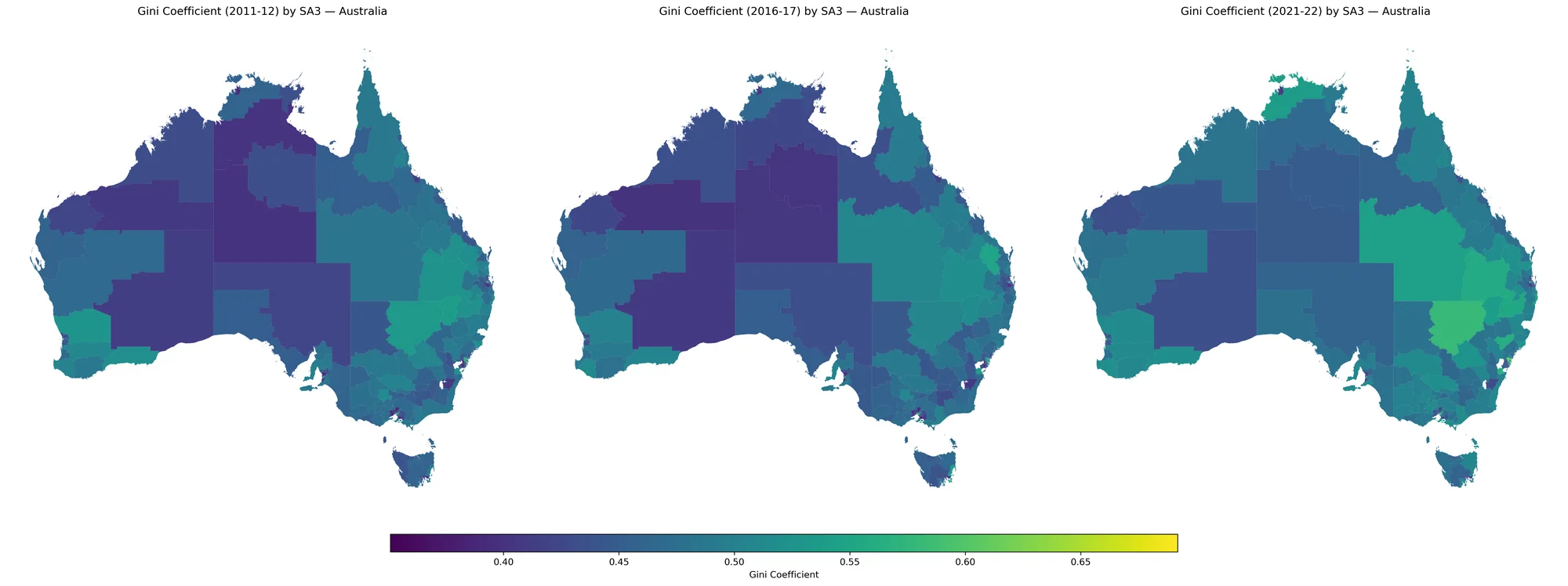
An illustration of local income inequality in 2011-12, 2016-17, and 2021-22 respectively. Higher Gini coefficients (i.e. lighter colours on the map) indicate greater inequality. The trend is that local inequality is becoming more pronounced in Australia over time (especially after the COVID-19 pandemic) (Source: my analysis of Australian Bureau of Statistics income data, © Commonwealth of Australia, CC BY 4.0; analysis and visualisation adapted by Aditya Pande).
What I found
People earning below the average income
Widening income gaps were linked to poorer mental health among below-average earners. Lower-income people in midlife also appeared more sensitive financially.
Non-married individuals
Mental health and life satisfaction showed more negative patterns among non-married respondents, although the evidence was less clear.
Married individuals and financial satisfaction
Married men and women showed clearer declines in financial satisfaction as local inequality increased.
The overall picture
Financial satisfaction showed clearer differences between groups than mental health or overall life satisfaction.
These are associations, not proof of causation. Some subgroup patterns were less conclusive.
Why relative comparisons matter
Feeling financially secure depends partly on the comparisons we make. The research strengthened my interest in how income, community, and perceptions of success shape wellbeing.
A personal note
Fidget spinners and Nike sports bottles in middle school first made me notice how much our choices depend on what others have.
July - December 2024
Generative AI Recruitment Strategy
USyd Industry Project with Randstad Australia · Sydney
The problem: How could Generative AI improve recruitment and candidate matching?
My role: Team research, workflow assessment, and solution development.
Outcome: Recommendations presented to industry stakeholders, including implementation and ethical considerations.
Key Contributions
- Assessed recruitment workflows with a multidisciplinary team over six months.
- Proposed AI-assisted psychometric assessments to improve candidate matching.
- Presented recommendations covering implementation, business value, and ethical considerations.
April - May 2023
Airbnb Business Analytics Challenge
USyd Business Analytics Society & Alteryx · Sydney
The problem: What helps explain Airbnb guest satisfaction?
My role: Data preparation and analysis in Alteryx within a three-person team.
Outcome: First place in the University Business Analytics Challenge, with recommendations presented to Alteryx staff.
Key Contributions
- Built Alteryx workflows to clean and analyse Airbnb data from Sydney and Melbourne.
- Explored guest reviews, amenities, and location to identify factors linked to satisfaction.
- Presented practical recommendations to Alteryx staff alongside the winning team from Deakin University.